Wednesday, 29 November 2017

Thriller Characters

In a thriller story, the two main focuses of character archetypes are protagonists, victims and antagonists. There isn't a main person or stereotype to base these archetypes on, which drives forward the fact that anyone could be a protagonist, a victim or an antagonist of a thriller situation. 
That being said, most thriller films to date hold men as being the protagonists and antagonists, and the females are seen as the victims.

In addition, the female role is:
  • the stereotypical victim of the story
  • Young and vulnerable
  • having opposing characteristics of the antagonist
  • needing to be saved by a protagonist
  • gets captured or worse by antagonist
  • portrayed as being beautiful and sexy for male audiences as eye candy
  • Mostly survives at the end of the story
  • A female scream is usually a sign of danger

And on the other hand, the male role is:
  • portrayed as both the antagonist and the protagonist
  • independent and sometimes emotionless
  • in shape to show some physical appearance as strong
  • the strong powerful lead role, demonstrated by low-angle shots
  • a different ethnicity to the antagonist
  • sometimes portrayed as the more important role over females.

For examples; Psycho, Nightmare on Elm's Street and Scream use vulnerable female characters up against a mysterious male character with a cloaked identity, either by lighting and camera angles or with literal masks and cloaks. Jaws takes a different approach however making the antagonist the shark and the humans the victims, but keeps the same tropes making the shark hidden throughout most of the film.

Friday, 24 November 2017

Individual Distributor- Warp Films

The film company that I thought would be suitable to distribute our film was Warp Films. Warp films is an independent film and television company based in Sheffield and London, UK with further companies, Warp films Australia based in Melbourne, Australia. The company was founded in 1999 and its main focus is on more niche and gritty films.

I thought this fit well with out films genre and overall narrative as it is a physiological, mystery/Thriller which can be seen as a more niche genre as it is more of a sub genre. Warp films have made many films over the years with them being most famous for films such as This is England and Four lions. Many of there films feature odd or unusual narratives that try to avoid the typical conventions of the genres. One of their films, Four lions featured 4 aspiring terrorists that live in England, Sheffield that want to become suicide bombers. This films gained a lot of controversy because of this as it went into things that typically are not explored in film.

I thought this would be a suitable company to distribute our films as it fits with both the style and genre of it and our film targets similar audiences that Warp films does so I think it would work well.


Shot list - Darkroom -


Thursday, 23 November 2017

Thriller Storylines

Thriller Film is a genre that revolves around anticipation and suspense. The aim for Thrillers is to keep the audience alert and on the edge of their seats. The protagonist in these films is set against a problem – an escape, a mission, or a mystery. No matter what sub-genre a Thriller film falls into, it will emphasize the danger that the protagonist faces. The tension with the main problem is built on throughout the film and leads to a highly stressful climax.
Most thrillers take full in trying to accommodate Barthes theory on narrative and storylines, where the director tries to get the audience to pay attention to their film, using anticipation alongside expectation, and also identifying the movie using the "Codes": Enigma, Action, Semantic, Symbolic and Cultural.


The enigma code narrates a set of puzzles to be solved, raising questions as the plot continues which engages the audience, and a good way of delaying the ending of the film. The Action code showcases behaviours and actions that lead audiences to expect certain consequences based on past stories and their conventions. The Semantic Code takes the meaning of characters, objects and locations and how they apply to the story. This is better understood when comparing the semantic code of one film to another. The Symbolic Code is similar and symbolises features often signify oppositions and antitheses. Lastly the Cultural Code shows characters, locations and objects that represent a time period and location, and the references enhance our reading and understanding of the text. Romeo and Juliet have been remade into multiple timelines and Cultural codes.

Target Audience

The target audience for our film will primarily be targeted towards the ages of 16-30 however our certificate is a 12 but people younger than the age of 16 may find the film hard to understand and to follow along with the narrative. Our audience will be a mix of male and females as even though our main protagonist is a male I think both genders will be able to relate to our character and the genre we have picked which is a mix of mystery noire thriller which usually has a broad audience. There are also some dark underlying themes and horror-esque elements with a large theme of our film being  mysterious.


Our film is niche in its conventions and storyline as we are using the film noire style of black and white which mainstream audiences may not enjoy as they are so used to colour in the films they watch, so we will target a more niche audience as they can appreciate the style and direction we have taken our film but also enjoy our storyline as it is a mix of many different genres which may confuse a more mainstream audience. Our distributor will also be independent so will mean the marketing and cinema distribution will be low as the budget will not be as high as a larger conglomerate, so this in turn may also affect our audiences and who we can target. Other films our target audience may watch would be films such as memento or schindlers list as they have similar style direction as ours but also have a element of mystery to them.


Our target audiences hobbies and interest outside of film would be things such as photography as our main protagonists interest is photography and is one of the main narrative devices in our film. They may also enjoy art and filmmaking as our film features styles that are usually unexplored in todays cinema.

Thriller Genre: Titles

Titles in thriller films set the theme of the feature you are about to watch. To start, most thrillers have a lot of either dark imagery, dark colours, or both. An example of using dark imagery without actually using any dark colours would be 2013's "Hannibal". The title doesn't have any dark colours at all, but rather showcases an animated scene of faces being constructed in blood-red liquid, resembling wine. The fluid showcased here most likely resembles Chianti, a Tuscany wine which Hannibal Lecter has said to drink while dining on cooked pieces of human flesh. Visuals aside, a lot of the horror-core music make our senses tingle and stand on edge, setting the theme to be a thriller.


Contrasting this would have to be the use of dark colours over dark imagery, from a 1990's story show "Are You Afraid of the Dark?", creating unsettling imagery with very dark colours, giving almost blue silhouettes to the objects around inside. In addition with unsettling sound effects and music, the scene represents childhood memories in the darkest light, assuming to make everything mundane as creepy as possible.


Not all thrillers however have to convey horror themes behind them. Some can even make the audience feel another emotion that commonly comes from thrillers: Panic and paranoia. 2010's "Rubicon" Conveys this message almost perfectly with it's quick swipes of the camera following a yellow highlighter joining up pieces of information together with an intention of feeling paranoid with each swipe of the highlighter. The brass instruments along with the computer-generated sound effects makes this opening similar to a bond film, which usually contains themes of spying and thriller too.


Certification

The certification of a film is a description of a film that classifies it under certain rules and guidelines that limit ages from viewing visual content due to inoculations against themes.

Due to this, I have conducted some research into what our short film would be classified as.

Certification: 12
A film is certified to be a 12 if it meets certain requirements that mean it is more suitable to younger teens. This includes infrequent or little use or misuse of drugs with no glamorisation of them. No promotion of dangerous, and imitable behaviour which children are may copy, this includes anti- social behaviour, this includes making weapons glamorous.
The film may feature Bad language depending upon in which way it was used as well as how frequently it is used, however this is mainly moderate.

Nudity is also allowed, however, if used in a sexual manner must be brief or discreet. This also goes for sexual activity.

Threat is also allowed however in moderation. This includes both physical and psychological threats. It is also permitted for disturbing scenes to be used however the overall theme of the film should not be disturbing, meaning horror elements are infrequent.
This is the same for violence, including sexual violence and gory scenes if justified by context or brief and discreet.

Why our film should be a 12 Certification

Our proposed film features many elements that provide a sense of unease, such as the inclusion of missing people/children creating a threat. The threat used is to propose the dangers and real life threat of missing people and how easily and unnoticed many missing person cases can be.
 The film itself does not include the use of Nudity or sexual behaviour as it only imitates the acts of a 16 year old photography student.
The film itself does not reach the explicitness or more matureness of content, as there are no scenes of intense violence, language or other imitable behaviour that could potentially resort in the film to be classified for a 15 certification.

Missing Poster- Rose


Script Draft 1


Tuesday, 21 November 2017

Distributors


Goldcrest Films


Goldcrest provides innovative financial solutions across the media sector, from independent producers to the major studios and has funded films ranging in budget from $3 million to $98 million, of which four have opened at number 1 at the US box office. 
Notable credits include Twilight ($400 million worldwide box office), multiple Academy Award nominee Revolutionary Road ($76 million worldwide box office) and multiple Academy Award winner The Iron Lady ($114 million worldwide box office).


In addition: Goldcrest is a leading sales and distribution business, working with third party producers to develop, package, finance and distribute their film, partnering up with the foremost distributors globally, implementing strategies at each stage of production and exploitation that maximize the value of the film to buyers and audiences.


They monetize a growing library of prestigious, commercial titles. The backbone of this is the celebrated Goldcrest Library; over 100 titles responsible for 20 Academy Awards for which they have distribution agreements in place with five major US studios and key independent distributors in over 50 territories.


I believe Goldcrest Film Distributors can help publish our film as they cover a wide range of genres, including thriller, and has published quality films, but not exactly box-office standard, which I believe our film will be.

Monday, 20 November 2017

Preliminary tasks - Unrestricted and restricted narrative

Unrestricted
A unrestricted narrative shows scenes in a film that cuts between two separate characters that hold some resemblance between each other. The audience knows about two or more separate characters at the same time to expand on the story in different ways that will eventually link together in the end. This makes complex story lines easier to understand, and this kind of narrative is common with more horror films.


Restricted
A restricted narrative shows the film from only the perspective of one character, constantly having them in most of the shots. This leaves chances for audience to be surprised as much as the main character when events occur. Restrictive narratives appear more frequently in short films rather than longer and better quality films, as it holds the interest of audiences just long enough before the film gets boring.
Restrictive narrative can also be useful when throwing the audience into a character's flash back, such as I am Legend and The Road. It's mostly seen in thriller and crime films as we experience the events for the first time as does the characters in the film.


Sunday, 19 November 2017

Thriller Genre: Titles

The mystery thriller genres are there to make viewers question what is happening whilst also gibing them elements of shock and suspense by providing build-up that causes anticipation and anxiety.

The titles/introduction of a film needs to describe this to help draw in the audience by providing hints at these by creating an element of this thrill. They also tend to use dark imagery or colours creating an unsettling air of mystery. One example of this can be Agatha Christie's Poirot (1989). This uses the cryptic inclusion of the actor whom plays Hercule Poirot, this is scene to create a sense of mystery as he is covered by mysterious shapes almost like smoke to use shroud him in mystery.
The thriller elements of this title sequence is shown with the inclusion of pastel coloured animations showing a biplane and a train entombed by smoke and fire. This animation continues and proceeds to show a magnifying glass and a gun showing potential elements to the story. The use of dark colours draws in the audience as a enigma is made, in which they want to find out who this character is and what the use of the gun would be for.

A contrast to this would be the creation of dark elements without using dark colours. one great example of this would be the 'Hannibal'  series in 2013, which uses strong red colours and animation of faces to represent the thrill and horror related elements that the show consists of. The use of these animations show the use of blood to envelop feelings within the viewer. This paired with the music convey a horror and underlying feeling of emotion, whilst again providing that enigma of what it involves.

However, many thrillers do not always convey horror, they play on the newer and more modern view of horrors and thrill that are based on conspiracies, government cover ups and terrorist organisations, a prime example of this is 'Stranger Days' (1995) (http://www.artofthetitle.com/title/strange-days/#)
In this title sequence we see the use of almost sci-fi related fonts, to then be greeted with the introduction to a heist. This already provides a heightened emotion whilst also providing a first person view of the entire event that takes place.
This 'straight into action' take on the title scene allows the audience to be drawn in with th thrill of being immersed in the crime as the first person view provides a more realistic take on the action at hand. The use of the contrast between the sci-fi-esque elements, although related to the films plot, provides a edge of seat experience that all thrillers aim to have.

Tuesday, 14 November 2017

Treatment

Treatment

Title

Dark Room

Film Length

Up to five minutes (short Film)

Audience

Male and Female aged 16-30 (Niche) Predominantly Male.
The target audience will be this age range as there are dark underlying themes and horror-esque elements. Our audience will be interested in mystery films and many puzzles, they may also be interested in the niche storylines as well.

Certificate

12/15 Using the BBFC standards
Even though there are horror elements and darker themes, it features little, to no swearing. We believe that many of the actions are not realistic enough to warrant anything higher and thus cannot be very impressionable


Distributor

Warp films

Synopsis

 A college student finds a camera in an attic in his own house he is a student photographer. He takes a photo of a flower in the ground and walks away. The camera pans from him and zooms into the flower with a pull focus and it reveals that the flower is gone without the protagonist knowing that it isn't there. He carries on with his day taking more photos. He goes home and takes a picture of his cat for it to again like the flower disappear without the main antagonist knowing again. He begins to take pictures of people with each time him either looking down at the camera or walking away with him being oblivious to the fact that the objects and people that he is photographing have gone. He goes to a darkroom to develop the photos he has taken, and he notices something off about each of the photos but carries on developing them anyway. He hears subtle screams and looks towards the photograph to notice that the expressions have changed from last time he looked at them. This begins to make him anxious and begins to question the camera that he bought earlier in the day. He takes a self portrait and there is a deafening silence and flash from the camera. The camera falls and smashes onto the floor.

Suggested elements

Suggested elements tend to be the main selling points of a film in which provide a unique experience for its viewers.
In our film this will include:
The film including the film noir elements, such as having black and white colour schemes and cinematography closely relating to the film noir and mystery genre. This would lead to our audience consisting of more niche groups as our film could be classified as being more art nouveau rather than being  mainstream. Our narrative is mainly restricted however contains hints of omniscience as the audience gains subtle hints along side our main protagonist leading to them knowing certain story points that our characters are unknown of. The genre of the film also allows us to help gain visceral response from audiences.

Monday, 13 November 2017

Films similar to ours

I began researching into other films that are similar films to ours to give me insight into what we can include for ours.

Polaroid
High school loner Bird Fitcher has no idea what dark secrets are tied to the mysterious Polaroid vintage camera she stumbles upon, but it doesn't take long to discover that those who their picture taken meet a tragic end.

This film is very similar to ours in its story line as the main character both find an old polaroid camera and have it as the main plot device. However the overall conventions of our film differs to this one as we are going for a mystery thriller approach rather than horror. Whereas Polaroid is more horror-esque in the way it is presented as the characters die one by one with the camera compared to our film where they are only trapped within the poster.

Schindler's List

The narrative of this film is set in a a German-occupied Poland during World War II, Osakr Schindler gradually becomes concerned for his Jewish workforce after witnessing their persecution by the Nazi Germans.

This film is also similar to ours but this time not in a narrative way, but similar in Mese-en-scene and cinematography and also the stylistic choices it has. This is because we are making our film a mix of  styles such as Schindlers list as it utilised both a film noire and black and white style giving each scene many connotations surrounding colour, which is what we intend to do for our film.

Memento
The narrative for this film follows a man who juggles searching for his wife's murderer and keeping his short-term memory loss from being an obstacle.

Lastly the final film that I found was similar to ours was memento as it uses the narrative device of photographs and tattoos forefront in the film. We wont be using tattoos as a narrative device in our film however photographs will be also be a large narrative device in our film which will be used to inform the viewers of the narrative in a subliminal way.


Friday, 10 November 2017

Thriller Titles Research

The purpose of titles in films or credits is to inform the audience as to what may happen in the film, however they may be more ambiguous and only hint to some of the themes in the film. The titles sequence in thrillers and films in general are usually accompanied by text specifying who helped make the film, who directed it and who starred in it. Another aim of a title sequence is to entice the audience and interest them in the film before it even begins as to sort of invest them into whats going to happen. The titles also tend to use similar colours and themes that the film will feature as to link it to the film and give a sense of continuity to it all. Thriller generally focus on the mystery of the whole narrative and usually begin to build upon this within the title sequence. One example can be seen in Fight Club, while the film is not directly a thriller it has hints of the genre within it as it creates mystery from its titles. A hard rock style music is accompanied by brain neurons that the camera tracks through, the name of the films is shown, and all of the cast and crew that helped create the film. The sequence ends by coming out of the brain and is revealed to be the main protagonists that the camera was panning through. Having done this it links directly to the film as it transitions straight into it with a gun to the characters head that builds upon the mystery.  The main focus in this sequence is the text rather than the background imagery as the imagery doesn't really link to the film mcuh if you haven't already seen it.


A comparison to this would be the thriller film Black Swan. The title sequence in this takes on a more hand drawn style and features much of the iconography and themes from within the film as it used a similar colour palette and has the theme of swans throughout the sequence. This is accompanied by orchestral music with the cast and crew text coming up in the bottom right corner. For this title sequence the aim is more on the imagery in the background rather than the text as it gives hints to the audience what the film is going to be about.


Thriller title sequences can span across many different styles and themes as it is a very large genre but they play a large role into giving the audience hints into what is going to be in the film while also notfying the audience who helped create the film and what actors are cast in it.


Narrative Theory

A narrative or story is a report of connected events, real or imaginary, presented in a sequence of written or spoken words, or still or moving images. There are many types of narratives and theories behind each.
A narrative is defined by David Bordwell as ‘a chain of events in cause-effect relationship occurring in time and space’. Although causality (and time and space) is central to narrative, films may also make use of different principles, such as parallelism, whereby two separate lines of action are intercut in order to allow us to compare and contrast. Network narratives (Pulp Fiction, Babel, Crash, etc) – which show parallel lines of action and conceal causal links – are also increasingly popular.

Unrestricted narration
A narrative which has no limits to the information that is presented (gives as much info as possible, not hiding any pieces of information to the audience (unrestricted) i.e. a news bulletin.
Restricted narration
Only offers minimal information regarding the narrative (offering little amount of narrative which hides some information from audience, perhaps to create enigma/mystery) i.e. thrillers.

History of Thriller

1920's & 1930's
In 1926 Alfred Hitchcock ( A British director, who directed many famous thriller films) released his first thriller 'The Lodger', a silent thriller that followed the notorious killer, Jack The Ripper with the plot being about him. The thriller movies released in this time period, could be said to be the most key thriller films produced as they basically started or at least made the thriller genre be popular. They used techniques that are widely recognised as the codes and conventions of the thriller genre; through the repetition of codes and conventions audiences can now easily see when film is a thriller as they use these said codes and conventions.
1940's
Image result for shadow of doubtIn the 1940's Hitchcock continued to release suspense-thrillers:
-Foreign Correspondent (1940)
-Rebecca (1940)
-Saboteur (1942)
-Shadow of Doubt (1943)

George Cukor's another director, directed a psychological thriller called 'Gaslight' in 1944.

1950's
Again in the 1950's Alfred Hitchcock released more thriller films however this time making a massive change to the genre by adding Technicolor to his thriller, which meant they were no longer black and white, but also added a touch of glamour to his films by casting 'icy blondes' to play the leading ladies in the films.

Hitchcock films in the 50's:
-Strangers on a train (1951)
-Dial M for Murder (1954)
-Rear Window (1954)
-To catch a Thief (1955)
-Vertigo (1959)

1970's & 1980's
Thriller films in this era began to edge close to the horror genre, adding violence to the mix, while still maintaining the clear difference between the two genres by use of the codes and conventions.
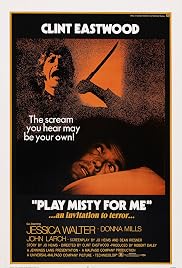
Image result for play misty for me
Some Thriller films released in this era:
-Frenzy (1972) Alfred Hitchcock
-Duel (1971) Steven Spielberg
-Play misty for me (1981) Clint Eastwood

1990's
In this era the genre didn't see much change or difference from the era before however more and more thriller films were being released as the genres popularity arise with audiences.

Thrillers released:
-Misery (1990)
-Sleeping with the Enemy (1991)
-The hand that rocks the cradle (1992)
-Unlawful Entry (1992)
-Single White Female (1992)
-Malice (1993)
-The talented Mr.Ripley (1992)

21st Century
During the 21st century the thriller genre moved even close towards the horror genre. Films contained more blood , gore and deaths. Also combining codes and conventions of action movies into the mix of them. The plots were also modernised rather than re-using older ones. They did this by having the plots involve government conspiracy, terrorism and large world-wide issues.

Thrillers released:
-Eden Lake (2008)
-P2 (2007)
-Hostage (2005)
-Cellular (2006)
Image result for eden lake-Firewall (2006)


Thursday, 9 November 2017

Thriller locations

Thrillers can take place in many different locations ranging from cities to more rural areas however there are the typical locations that are stereotyped to the thriller genre.

However there are some typical locations associated with thriller and they are used for some reasons and the aim is to generally have a more closed off and maze like location that the protagonist struggles to get around, this in turn could be used to give off a sense of claustrophobia to the audience and character building on the thrilling feeling and tension.

The locations generally are:
-Cities/towns i,e alleyways
-Large houses or lodges in a more cut off area
-normal home environments
-forests/woodland areas with few houses
-abandoned buidlings

The reason why these locations are used is because they are better at creating tension due to many reasons. For example for forests or cut off areas, this can give the character a sense of isolation which can be evoked within the audience as well. These locations are also good to give off the sense the the character is being stalked or watched as they have no help and is harder for them to see the protagonist. A forest can also seem endless so can evoke the sense of hopelessness and that the character may never escape.

Although abandoned houses and forests are the typical location in thriller films, some thrillers can be based in a normal home or city where nothing odd seems to be happening. This is because it can give the character a sense of safety as they are within there own home which in turn can make the audience feel safe, so when something bad does happen the tension and horror is heightened. Alleyways are also used frequently as it gives off a sense of claustrophobia and a eerie feel if it is at night.

The time of day in thrillers usually begin in the morning or midday as the light represents safety for the character whereas later on in the film it may transition to nighttime and begin to get dark giving off am ore urgent and tense feeling for the character.

Production Logo: Process

Step 1) As a group, we first decided on which font type we would most likely use to be our official group font type. We needed for it to be professional, but still entertaining to notice and recognise by audiences. After talking we decided to go with the 10th image at the bottom of the pile, known as "Ostrich Sans Inline"
Step 2) Because our logo revolves around cinema and the majority of the producers of SpecShot wear glasses, we decided to base our main logo on the old 3D glass, despite the misunderstanding that no, our films do not come in or with 3D glasses. Below you can see a image from google and next to it is the traced result of it. This can be used later on for different darker backgrounds where the logo doesn't need the extra colour, but rather just inverted coloured lines to make it stand out enough for audiences to spot it.

Step 3) Already we are getting some ideas for our finalised logo from the text and the trace alone, experimenting with the logo in different ways. Here's a few examples: We eventually decided to go with the bottom image where the text was inside the eye holes.
Step 4) Now that we've got our logo shape sorted, it's time we gave it some colour. Below we took the time to test out different colour palettes and made 9 of the same logo in different colours.
FINISHED RESULT:

History of Thriller

The early forms of the thriller genre started out around the mid 1920's - 1930's with many films by Alfred Hitchcock, such as 'The lodger' which followed a Jack the ripper-esque plot in a silent format that allowed for a build up of tension and climaxing events, thus birthing and giving way to the thriller genre. These are said to have been the most key thrillers, as they provided the many elements including build ups of events and moments of shock that is the thriller genre.

In the 1940's thriller was all about suspense and a large build up drawing in the audience as they have many tension building moments and enigmas making them want to know what happens next. This development lead to the films: Foreign Correspondent (1940), Rebecca (1940), saboteur (1942), shadow of a doubt (1943) and the psychological thriller Gaslight (1944).
The 50's were a large plot for change especially with Alfred Hitchcock's change to Technicolor and addition of 'icy blondes' as leading actresses, almost acting as a femme fatale role. This lead to the Hitchcock films of: Strangers on a train (1951) and Dial M for Murder (1954). The genre remained almost unchanged for a few decades with the repetition if conventions setting the thriller genre in stone for future generations.

The 1970's were a point in which change was noticed with the thriller genre, this is where they tread closer to the horror genre adding elements of violence and horrific events, whilst still managing to keep a separation between the two. This includes: Frenzy (1972) , Duel (1971) and Deliverance (1972). The 90's furthered this edge into the horror aspects of thriller due to the increase of teenagers and youths indulging more in the 'horror for entertainment' trend that was around in the late 90's, this was furthered into the 21st Century with the addition of action and the extra blood, gore and deaths from the horror genre. Many of these plots were not conventional and were instead modernised by adding plots such as government conspiracies, terrorism and larger world wide issues. Notable films include: Eden Lake (2008), Unknown (2011) and Hostage (2005).

There were a few key people in the creation of the thriller genre, one of which was Alfred Hitchcock. through his films such as 'The lodger' created many codes and conventions that are used to day are a part of the standardised thriller genre, these key concepts include emotion and suspense building to create tension and anticipation finally leading to a shock twist at the end.
This developed to many key changes through the decades including the key point of modernisation of the stories. For example the inclusion of government and terrorist based plots. Eventually lightning and colour also became available allowing for film directors to use shadow to emphasise characters ulterior motives and darker sides.
As this progressed so did the music and sound effects to further build on the development of emotions and tension building elements of the story creating a further suspense.